My Voice in the Mountains

By Amber Smith

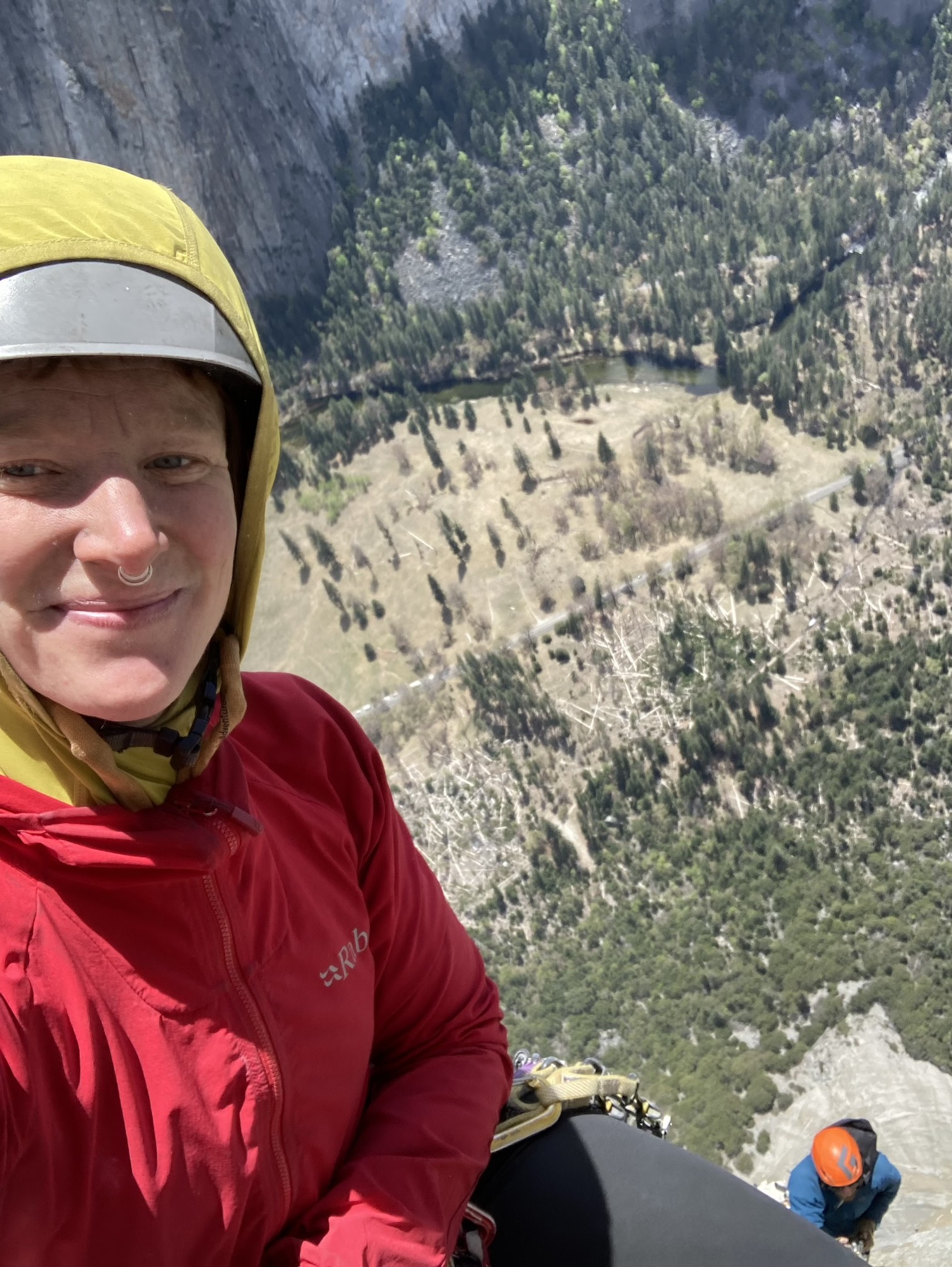
Amber leading the traverse on hooks and having so much fun.


It’s fall 2023 and I am nearly concluding my second season as a climbing guide at the Yosemite Mountaineering School. I am lounging on my back, tucked deep inside El Cap Meadow, basking in the radiance of the white granite. I have a secret. Despite many years of my life spent climbing and guiding in this valley, I have never climbed El Capitan.


Frankly, I feel annoyed at everyone’s obsession with this mountain. Many friends devote their lives to climbing her. When they are not climbing her, they sit in this meadow and worship her. And when they are not sitting in the meadow, they sit around a fire, and talk endlessly of her features.

In college I interned with the university’s Outdoor Leadership Development Program. Back then, I wasn’t interested in outdoor leadership, but didn’t have a car to drive myself to nature, so I joined anyway. I remember wearing my painted climbing helmet, thrifted wool sweater, and five finger barefoot shoes whilst standing in front of a student group. I desired to command their attention, but directing them required me to use my voice.


When it was time to speak, I would gasp, choking, like my airway was blocked. My stomach would churn in knots. I devised a strategy for this intimidating task: take a big breath, count one, two, three, then speak my truth! 14 years later, I traded my thrifted sweater for a logoed puffy coat, but standing beneath El Capitan, that same self-doubt lingers.

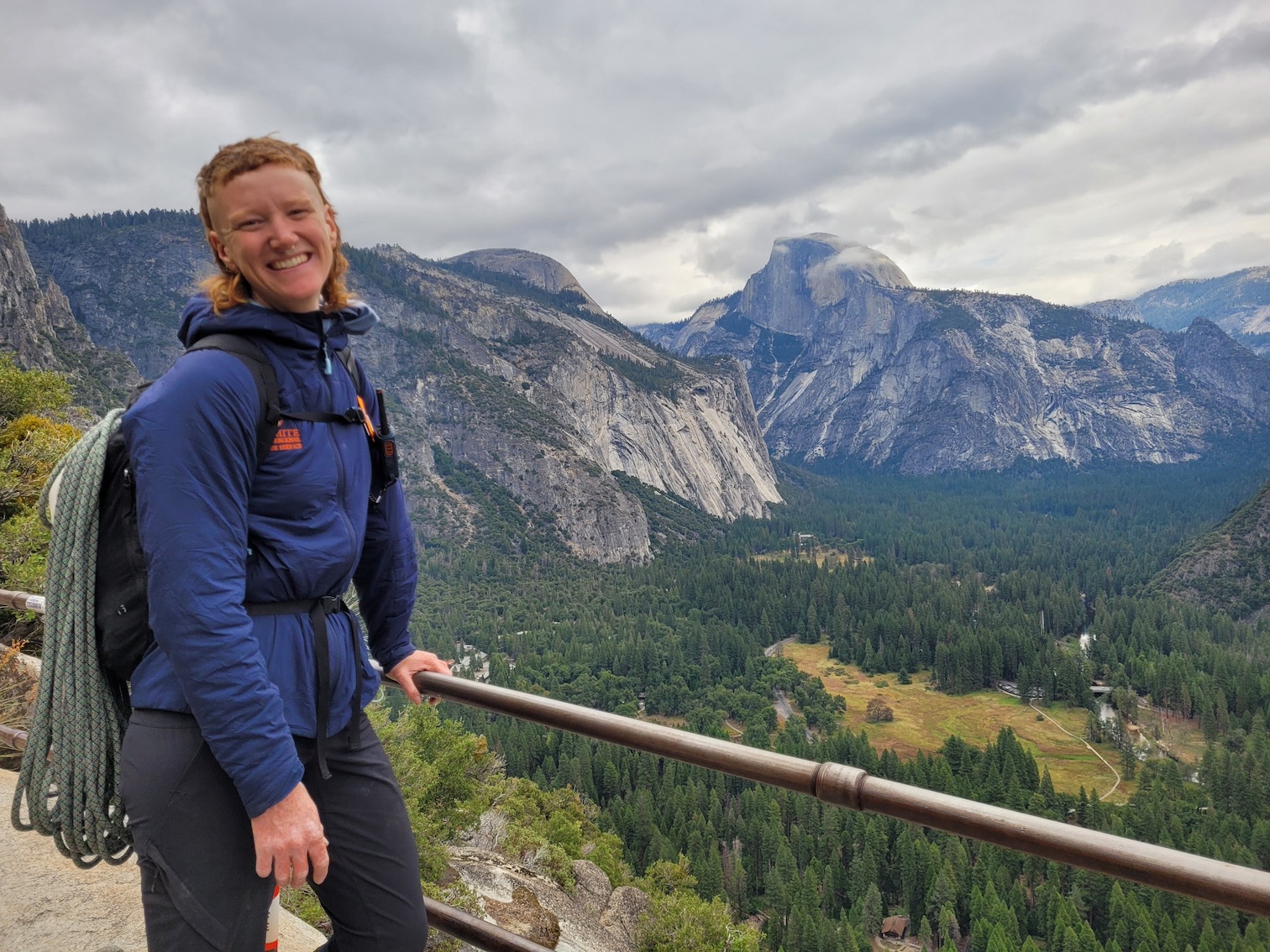
Amber descending the Falls Trail, after a day of guiding Commitment and Selaginella.


That’s not to say I haven’t tried to climb El Cap. There was the one time, part way up the Zodiac, we bailed due to a fierce snow storm. Another time, on my two year anniversary with my partner, we jugged up the heart lines and had a sleepover on the ledge. I even led all the pitches on the Freeblast. Multiple times, recommitting to my pursuit of aid climbing, I went up the first four pitches of The Nose.


I say recommitting to my pursuit of aid climbing because, full disclosure, I don’t like aid climbing. Before moving to Yosemite to work for the Mountaineering School, I guided for six years in the North Cascades. Aid climbing is the mountaineering of rock climbing. Just like mountaineering, you schlep tons of gear and grovel for days to the summit of a mountain. In my climbing, I want to feel light and nimble and graceful. I want to wear a sports bra in the sunshine and pull hard on extremely well protected routes, only to return home to my bed at night.
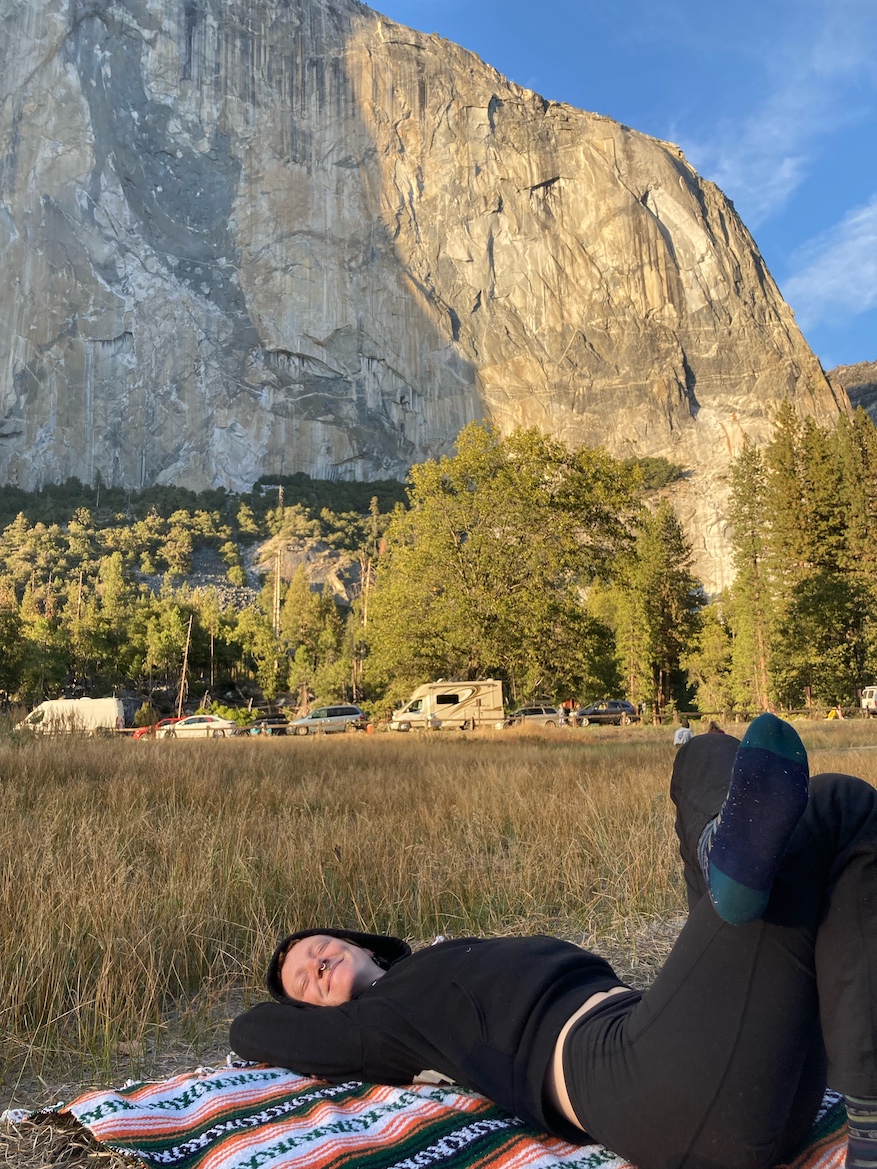
The Yosemite local past-time of lounging in El Cap Meadow.


However, this evening, alone in El Cap Meadow, I am actually contemplating climbing the mountain. Part of me wants to do it just so I can say “yes” when clients ask me if I've climbed it. An even bigger part of me wants to know if I am capable of doing it. The biggest truth here yet is that I’m really scared of this mountain.


This year, accidentally, without much foresight, I climbed all the entry level walls in-a-day style: Leaning Tower, Washington Column, Liberty Cap. They all went quickly and smoothly. In regards to fitness and skills, I am prepared to climb El Cap. But mentally? Emotionally? Spiritually? I decided that tonight, I would ask the mountain herself for an invitation.


I took a dose of a psychedelic and closed my eyes. When I opened them, I was terrified. The pine needles of the tree above turned to claws, grasping for me. The granite mountain morphed into a menacing skull and cross bones. Then at once, a giant, red “X” flashed, strobing over the mountain. I had my answer. I will not be climbing El Cap this season. The mountain does not invite me onto her.

A year prior, I was at an American Mountain Guide Association ski guide training, poised at the top of a couloir. My peer, the mock-guide, was trying to make a decision about skiing the line; the entrance looked icy. The group debated our options, using a slow, consensus style approach. My instructor got frustrated with our inefficiency and suddenly did something shocking: he threw his water bottle across the slope in a fit! Then, he audibly whined, ripped his skins, and declared, “we are descending.”


In the middle of that tense moment, I addressed the group thoughtfully and steadily. “Our group dynamic is dysfunctional, and so our ability to make decisions about risk and respond to hazards is compromised. I don’t want to step into more consequential terrain considering our poor teamwork.” I asserted that I would like to avoid avalanche terrain and descend back down the way we ascended. My heart pounded inside my chest from discomfort, but I felt confident my comments were necessary and valid.


Unfortunately, in the following minutes, my voice got overpowered. The instructor asked if he could take over with a demonstration. I succumbed, not wanting to hinder the learning opportunities for myself and my peers. What happened next was one of the strangest experiences of my career yet: the instructor led us to the top of a visibly wind loaded chute and coached us on how to manage the terrain, all while making off-handed comments like, “I wish I were wearing my air bag.” His comments revealed how little confidence he actually had in his demonstration. We skied the slope and sure enough, it avalanched. Nobody was caught, carried, or injured, but the group was tense and bewildered.

Amber and her climbing partner Rachel at the top of Leaning Tower.

Six months after the avalanche incident, my coworker and I were participating in a guiding performance evaluation. We met at 5 AM to initiate our quickly formulated plan to climb both the Lower and Higher Cathedral Spires in Yosemite National Park. My coworker would lead South by Southwest, on Lower, and later, I would lead the Regular Route, on Higher.


At 3:30 PM, the Regular Route was in full sun. Smoke was rolling in from a wildfire that had started that morning. I decided to break my role for a moment and check in with my boss: the long day was catching up to us, the conditions were terrible, and I admitted, if it were up to me, I would not proceed up the route. Later, it was shocking for me to remember that I had voiced my preference to not proceed. In the next hour, events would unfold making me deeply regret compromising my opinion.

The climbing was run-out. I wasn’t getting nearly enough protection. No matter how many times I looked at the topo, it didn’t match the features in front of me. I called down for advice from my colleagues, but they couldn’t offer much. In a fit of frustration, I grabbed holds and mindlessly moved up.


I came to a small roof with a #4 crack. Unfortunately, I had no #4 on my rack. One tricky move and I'd be over the bulge with easier looking terrain ahead. I tried the move. It felt hard and sweaty. I retreated. “Ugh, this is taking too long, it's getting late,” I relented to myself. Try again.


My foot slipped on the smooth granite and I went flying. Still flying. Forty feet of flying all the way down to the belay. Fortunately, the rope went tight just in time so only my left foot struck the ledge. Embarrassed, and now suddenly on the belay ledge, I tried to stand up, only to discover my foot could not support weight. Later, x-rays would tell me I fractured it in seven places. Even with exceptional orthopedic surgery and physical therapy, I wouldn’t walk again for six months.


The remaining weeks of my 2023 work season passed quickly. I continued to contemplate my vision in the meadow. Was it a premonition? I wondered, if I go up there, will I actually die? Less than a year ago, my foot was broken on the Higher Cathedral Spire. So when the perfect El Cap partner on the perfect day lined up, I asked myself: is it worth it? What is my motivation?

Rhaude in the aid crux on Lurking Fear.

I decided vision’s purpose was to make me confront the possibility of getting hurt or dying. The mountain did not want me to go up there, only to confront that possibility inconveniently part way up. The mountain wanted me to confront this possibility and fully consent to the risk before embarking on any climb. Even more so, the mountain needed me to trust myself as the most qualified person to make decisions about my life. I decided with calm acceptance to go for it.


My climbing partner Rhaude and I were meticulous in our preparation. They had climbed Lurking Fear before and had excellent notes. We decided to fix 3 pitches and then go for the route in a push. We opted for full commitment; we would not bring a second rope that would enable us to retreat. Not only was I going to climb El Cap, but I was going to climb El Cap in a push!


We began jugging our fixed lines at 4am. Instead of feeling anxious, I was totally steady, even joyful. My full self was consenting to be there. I was present in my body, embracing the intensity and beauty of the moment. I led the first block, taking us up to just below the aid crux. I wasn’t fast and I remember the alarm in Rhode’s eyes as they arrived at that belay. Still, I felt assured.


Rhaude took over and I followed behind them, into the sunset and eventually into the darkness. At Thanksgiving Ledge, there were acquaintances camped and extra water stashed. We drank deeply, smoked cigarettes, and then I cast off to lead the final pitches to the top. Once at the summit, we briefly celebrated, before stumbling down the East Ledges descent trail in a tiny, weak headlamp beam.

A few years later, climbing The Nose. El Cap feels more friendly now, but it's still not my favorite mountain in Yosemite.

We arrived back at the meadow, and with the vague feeling of loss and exhaustion that comes with accomplishment, and I slept in the back of my truck. In the morning, my diesel engine roared as I drove out of the national park. Goodbye Yosemite Valley, goodbye El Capitan. Thank you for the safe passage, I’ll see you again come spring.


Almost exactly one year later, I am in El Cap meadow again. This time, I am sitting in the dust, in a trampled area below a large tree. Pine needles poke at my ankles. In my hands, I shuffle a large deck of cards, and pull one. I ask the cards, “What do I need to know about the upcoming weeks?” I am asking because soon I will depart from Yosemite Valley, to Red Rocks, Nevada, for my final rock exam with the American Mountain Guide Association. This exam represents to me my final transformation from shy girl to capable female mountain professional. My card is the Wheel of Fortune. I interpret this to mean that everything happens for a reason. Good times will eventually turn to challenging times, and vice versa.


At a sweltering gas station in Nevada, just days before the exam, my phone rings. My partner solemnly mutters, “He’s gone.” Our friend and fellow Yosemite climber had gone missing, and it was now verified that he had passed away in a climbing accident. The hot concrete under my feet suddenly felt soft and unstable. Along with a sensation of floating, I realize this upcoming week will be my ultimate test. All my grief, fear, and self-doubt were about to come to head with all my learned boundaries and earned confidence and skill.

Amber and her climbing partner Rachel at the top of Liberty Cap.


Four days into the exam, I’m dangling from my tether at an anchor, crammed next to my examiner, feet aching in my tight shoes. My peer is leading one of the earlier pitches on the route La Cierta Edad. “How do you cope with loss, while proceeding in this industry?” I sheepishly ask. My examiner earned some of my trust and I cautiously invited him into my world. He reported back something like, he doesn’t notice loss anymore. He continues, “I don’t see my friends that often, so when they die in the mountains, it feels like they are on an extended trip.” This answer unsettles me.


On the day of the memorial of my friend, the examiner calls to notify me that I passed the test. I am a certified rock guide: a decade-long professional goal complete! I continue to return to Yosemite Valley to guide each season and I’ve returned to El Capitan too. Each day, on my harness, in addition to cams and slings, I carry an invisible box. Inside this box are all the things I’ve learned from my experiences with this beautiful and challenging sport. Sometimes this box is heavy, but mostly it is useful. These are the things that inform who I am and how I move in the mountains.


amber smith

she/her

Amber is a Certified Rock Guide with the American Mountain Guides Association and has been guiding for over a decade. The first half of her career was spent in the North Cascades, where she climbed, guided, and skied many of the Cascade volcanoes via multiple routes. Later, she based herself in Yosemite National Park, where she climbed and guided hundreds of iconic granite multi-pitch routes. Amber climbs at the 5.12 grade on both traditional and sport routes across limestone, granite, and sandstone. But most importantly, she believes these accomplishments don’t define her as a climber. Over the course of her career, Amber has developed tools not only to perform, but to enjoy climbing. Through her business, the Embodied Climbing School, she teaches these tools to help others cultivate joy, presence, and confidence in their climbing. Learn more at www.embodiedclimbingschool.com.

arrow_right_alt

The best of women's adventures. In your inbox monthly.

Thank you! Your submission has been received!
Oops! Something went wrong while submitting the form.

Broad Beta is a platform for women to share grassroot stories of wild adventures, and the food, gear, and technical knowledge that accompany them. Our gear reviews provide objective, honest, and thoroughly researched opinions specific to women's fits. Sign up for our email list. We won't spam you and we won't share your information.

© Broad Beta 2022