
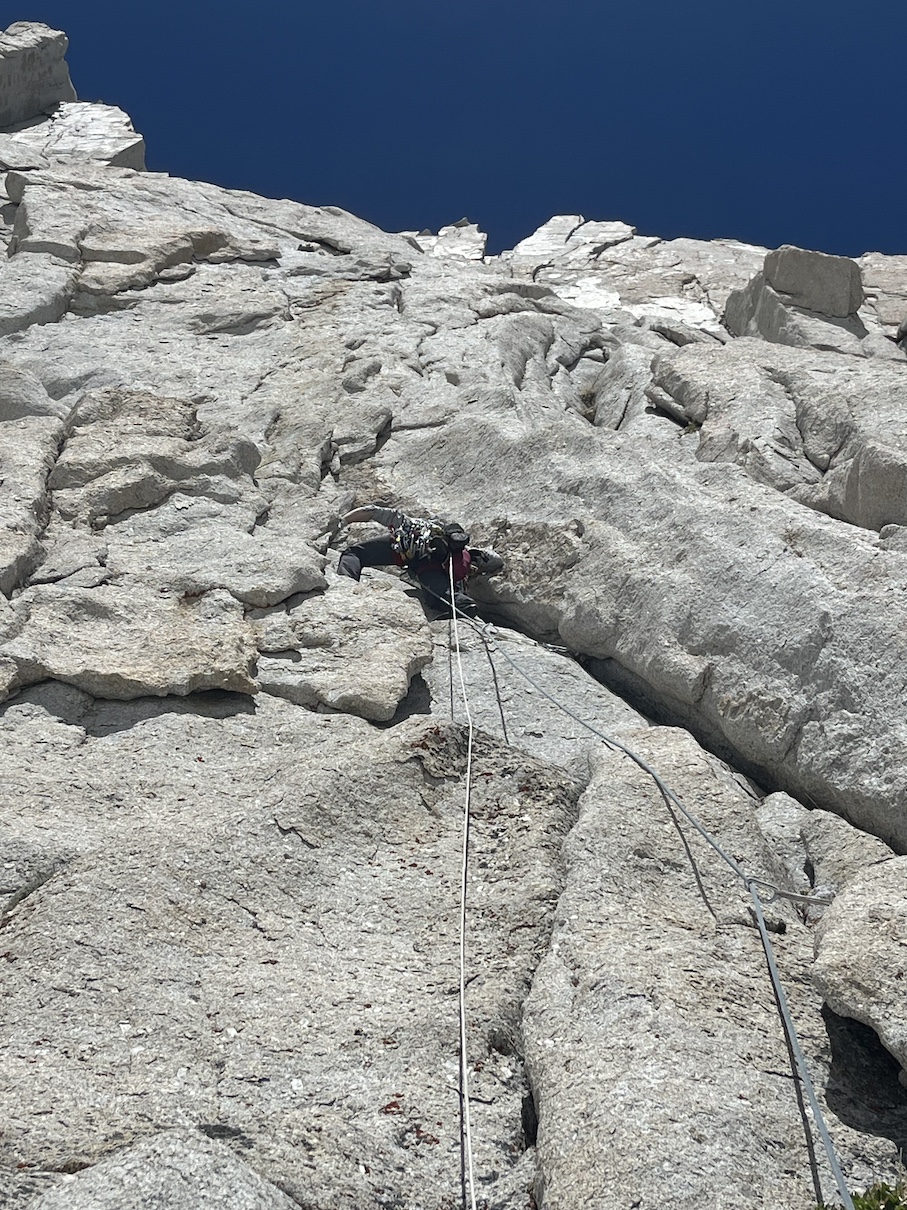
I looked up from my belay stance, my heart skipped a beat as 3 softball-sized rocks flew at me like missiles. No, no, no, I thought, not now, we’re almost finished. I was just starting to think about letting my guard down. Perched on a tiny offset ledge, I hugged the wall as they whizzed past and smashed into the wall below. My partner, Sarah, had just reached the belay ledge above where the rope rolled over and let loose the rocks. Tied in close to the anchor, feet swelling in the heat, I craved sitting down after hours of long heady pitches in the sun, but my survival instincts kept me upright and close to the wall, saving me from what could have been a helmet crushing blow. I rehearsed my mantra: “slow down, listen to what this peak is telling you, be patient, be more careful.”
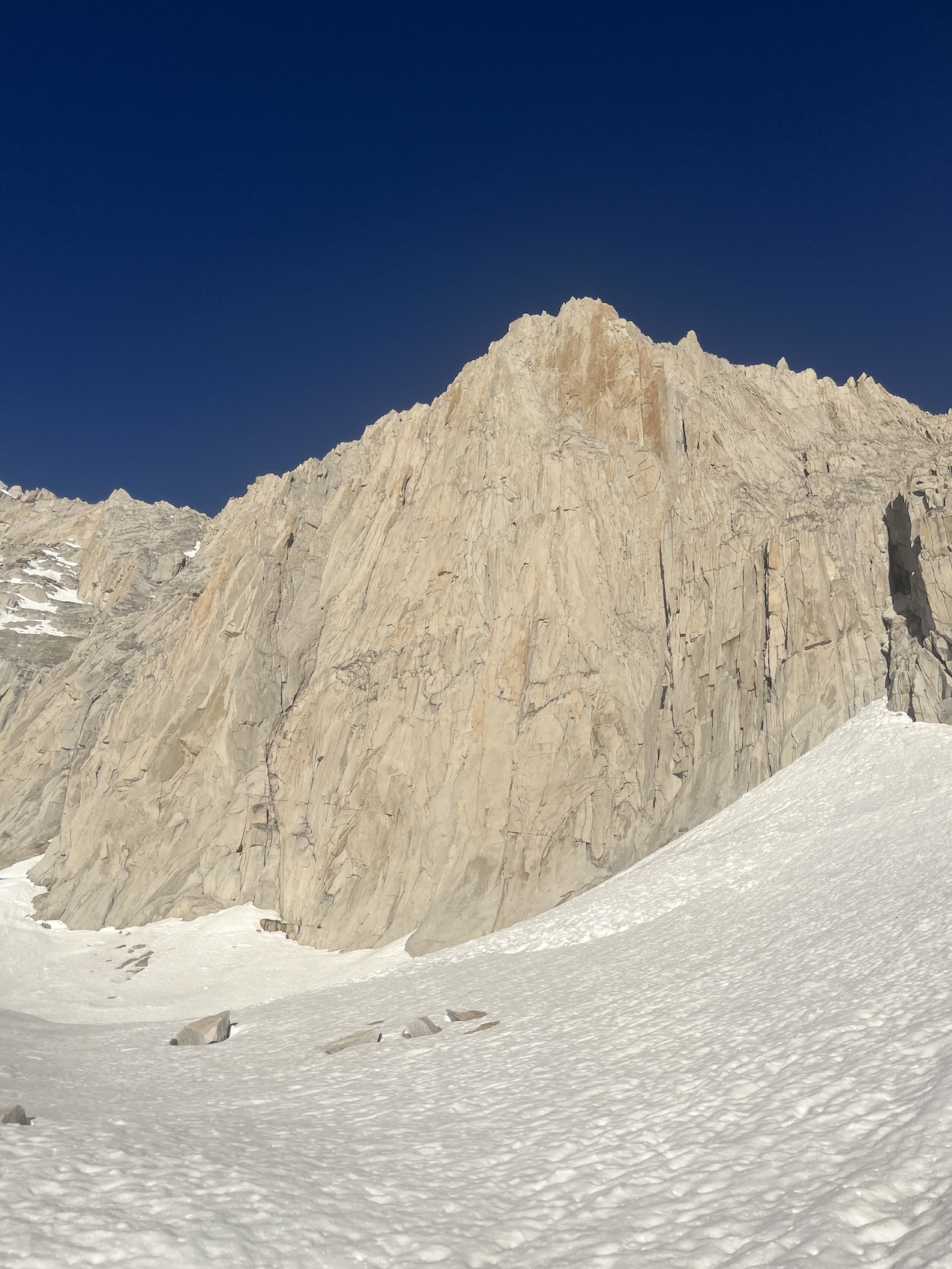
I like to joke that “low expectations are the key to happiness.” Sarah and I wanted a good “adventure” climb as our first foray of the season in the Sierra this summer. We chose a route and peak just up the canyon from my cabin, a little “backyard” venture. Ruby Peak is more like a massif with multiple mini summits and a long ridge line that wraps itself around the sparkling beautiful lake of its namesake below. Its splitter cracks and clean appearance are deceiving. It is notorious for its loose and exfoliating rock and a long and complicated descent. Keeping my expectations low allows me to stay more present with what is, rather than what I might hope for.
Last year Sarah and I had a surprise snow storm on top of Picture Peak and a wet-cold, loose gulley descent running from hypothermia and lightning. We both knew we could weather the unexpected epic with cool heads and hopefully, warm bodies this time. I trust Sarah as a partner who will pay attention. She’s an ex marine and strong in mind and body. We also both love camping by high mountain lakes as much as the climbs. Fortunately, Ruby is one of the most gorgeous lakes for camping you could ask for with a short approach. Our reward would be a refreshing cold plunge.
Being a new part time local, this climb felt like a rite of passage after years of exploring the Sierra while tent and open bivy camping, wandering the low and high country. The vastness of wild spaces and endless white granite are like none other in the world, drawing me back time and again. By chance, I now own a cabin with my niece in one of the most beautiful canyons on the East Side. Loose rock or not, I felt the pull to get intimate with the peaks behind my new, more permanent ‘bivy’ site. Launching into the unknown would make it more of a properly earned adventure. Yvon Chouinard, who I used to work for, liked to say, “It’s not an adventure unless something goes wrong.” I’m more inspired by his other opined quip, “If the trip is planned to the nth degree with no risk or surprise, then it’s just a vacation.” Rockfall is a surprise best avoided. Our unplanned descent route had plenty of potential for real risk.
Some rare alpine rock climbs are pure fun on the lead up and the experience - a good “vacation.” Others start with a low rumble in the gut, a sense of unease or trepidation. I appreciate the former, but I often crave the latter, the unknown descent and loose rock added the spice on this one. It was one of those climbs that could go seriously sideways quickly if we weren’t extra careful. “Trust your gut,” I thought, but I also knew that the rumbling was not necessarily emblematic of a coming storm.
I have spent decades alpine climbing but the lessons keep coming. I once rushed the rappels descending the West Face of the Mermoz in Patagonia, trying to get down before the team above set off deathly rock fall on us. On a rappel, I had put the tail of one rope into my belay device along with the other rope. It could have been a deadly mistake. Luckily, I almost always check my device and caught my mistake. Rushing almost cost me my life. My partner Lorna’s meticulous approach to our descent that day, despite my frustration with feeling we were going too slow, suddenly made me grateful. It’s easy to say “speed is safety in the mountains,” but it can come at a cost, as it has at times in my amped approach to life as well.
Sarah is good at convincing me to get an early start, which gets harder with age. I tend to fall into a deep sleep toward morning, after waking at 2 a.m. by my monkey mind spinning in circles. The vague light from the black moon (second new moon in a month) kept the 4 a.m. alarm from feeling like I was awakened from the dead. First light at 5 a.m. and we were off on the approach. The prior evening’s classic gear discussion landed us, surprisingly, veering toward the heavier, but safer side, taking lightweight crampons, some wind pants, and light fleece layers despite knowing we would be climbing in the sun for the first half of the day. My usual MO is to go so light I don’t want to even take a headlamp.
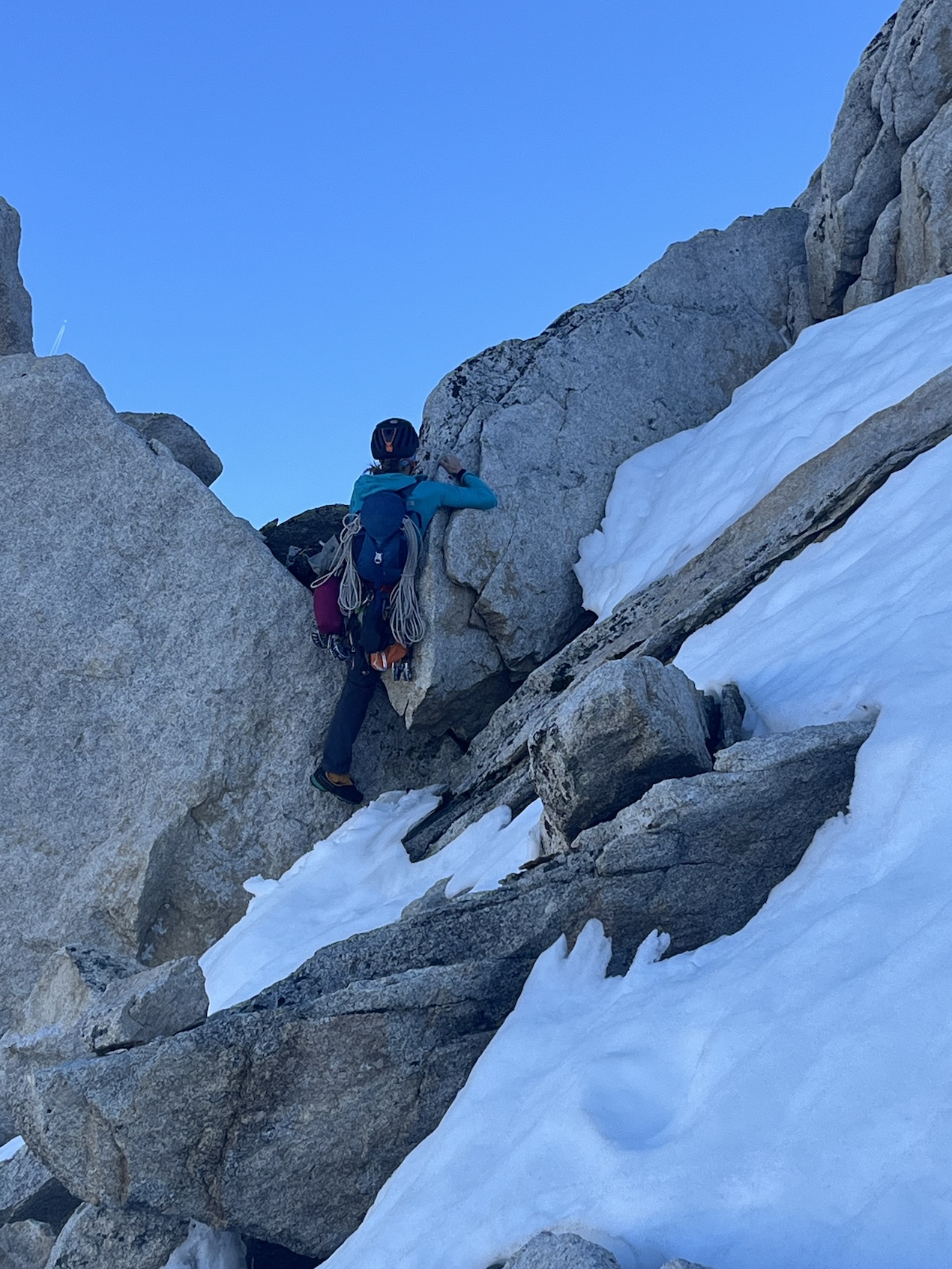
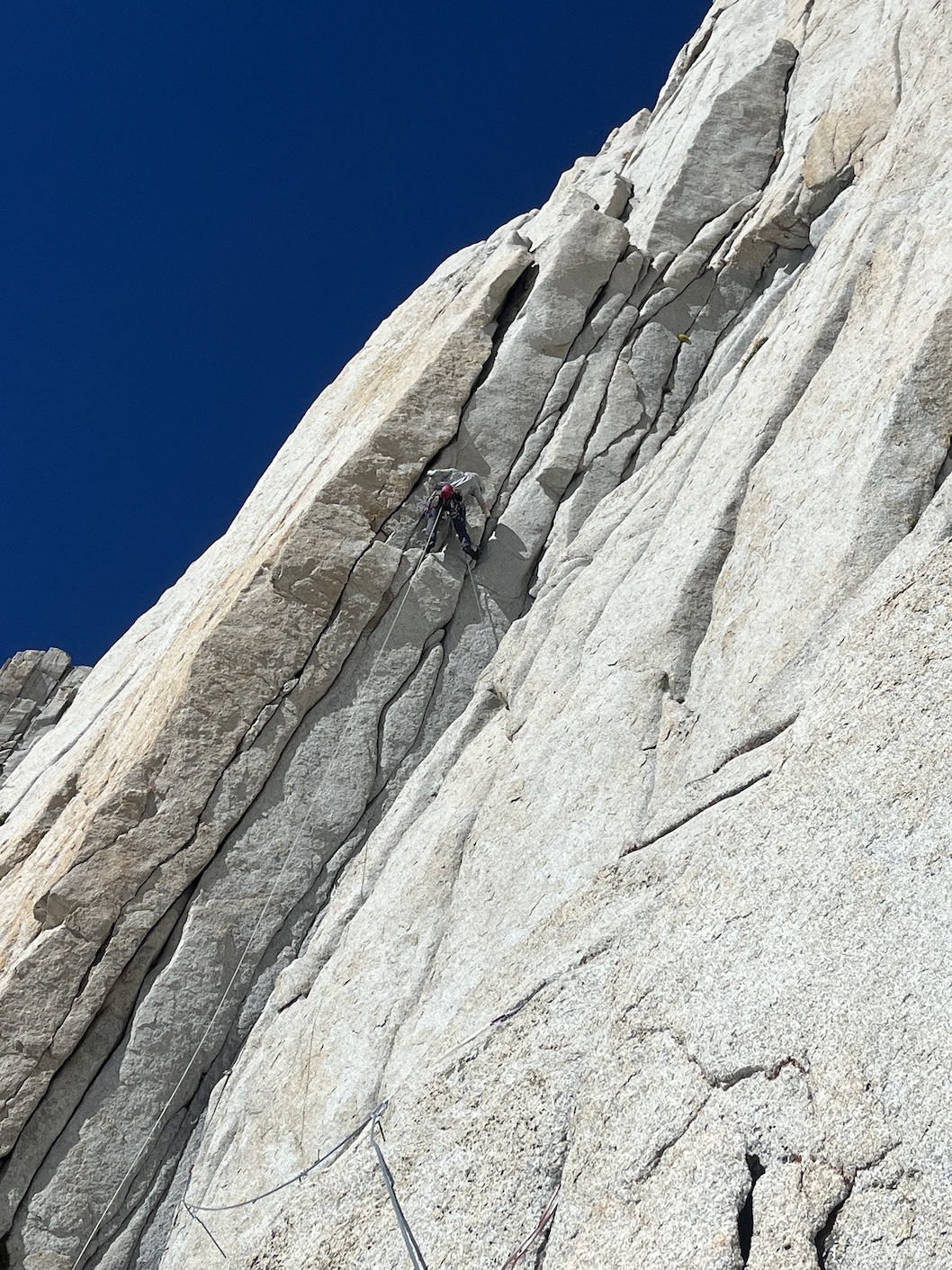
Pitch one set the tone as I launched onto a runout slab of exfoliating granite and a slippery feeling lie-back in a loose rock corner. What should have taken 30 minutes took almost an hour to lead 200 feet of intense attention-demanding climbing despite the moderate grade. The following pitches stacked up more of the same, with full rope lengths and senses on high alert. Testing every hold takes time, but when flakes of granite crush like crackers under your feet and hand jams, speed is relative. It wasn’t especially hard, but it was full engagement climbing.
As rocks flew by my head at the base of the headwall pitch, I felt a tinge of nervousness for the descent to come. But the beauty of this kind of climbing is the need for total presence and focus. Risk amplifies the senses. We had at least two pitches of wandering terrain above us. My mantra all day was to stay in the moment and keep focused on only the next move and pitch. We were not setting any speed records, but we were still within good time for navigating the descent in daylight. Unfortunately, long belays are the perfect time for my mind to dive into the abyss of the what ifs, which I’m notoriously good at pondering.
“You’re all spooled up,” a friend once commented as I was foaming at the mouth to get back to a big powder day from a trade show, thwarted by a highway closure due to the storm. It is not easy for me to slow down. I’m always thinking about what’s next. Climbing’s gift has been its imperative to stay in the present. Worrying about what’s next, what might happen, questioning how we will get up or down the unknown or horrendously loose, seemingly endless gulley, is part of my climbing practice. I’m a slow learner, but on this day my practice was paying off. A very good friend, revered climber and human, once gave me advice on a Patagonia trip that I hold to this day, “Worrying about what isn’t yet happening, distracts and wastes precious energy.”
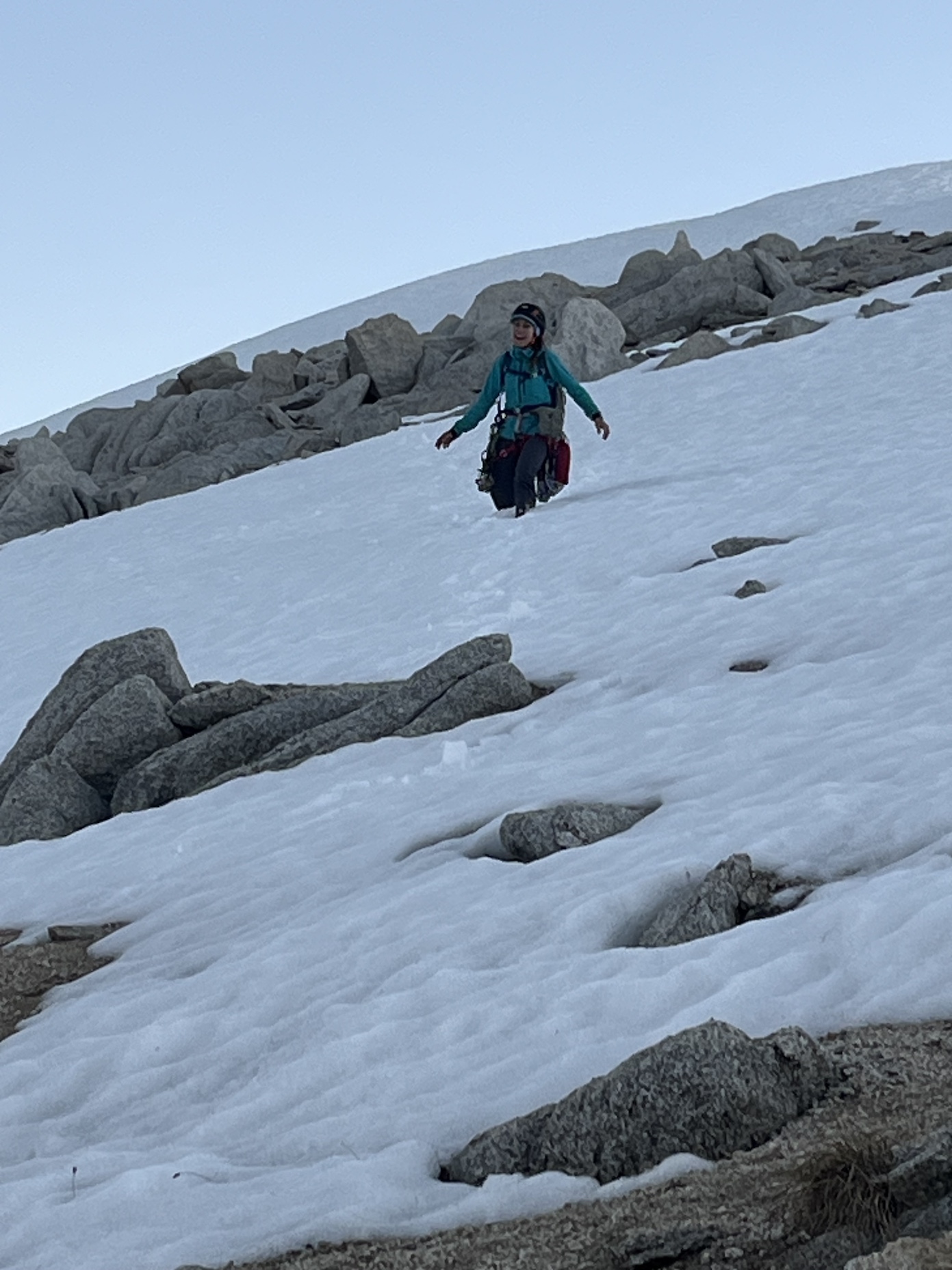
There were three decent options, a gully filled with ice, the south ridge, which looked to be a lot of loose rock and snow, and the north ridge, which looked longer but seemingly less technical. We chose north, which turned out to be long, technical and full of snow. The first gulley descent required endless down climbing on loose rock. Being one without a lot of patience, moves were a test of stability and mind. It’s so easy to feel defeated, that it’s not going to ‘go’ or that it will be too dangerous or take too long or that we’re not going the right way. Worrying can come so easily in these moments, but I have finally learned that each move and any progress is positive. It’s like aid climbing in reverse: slow, tedious, full attention movement where every step is micro-paced progress. The key is to take each boulder block a step at a time; there is usually a way around it. Patience is not a virtue here, it’s a requirement. The give and take with my partner are part of the challenge and the reward as we lean into each other for support, for a more positive outlook, for the energy to keep pushing forward. Or just the feeling that you don’t want to disappoint or bring down your partner.
Random footprints appeared from hikers going the opposite direction and gave us both a false belief that the next gulley gap would be easier to navigate. The mind preys on our weaknesses; this gulley proved worse than the former one. Finally reaching the ridge, what looked like easy snow walking turned into shin cutting postholing, but at least nothing was going to pull us off the mountain. Scrapes brought smiles. Relief is relative, and hope is a vain word in the mountains as some wise climber once said.
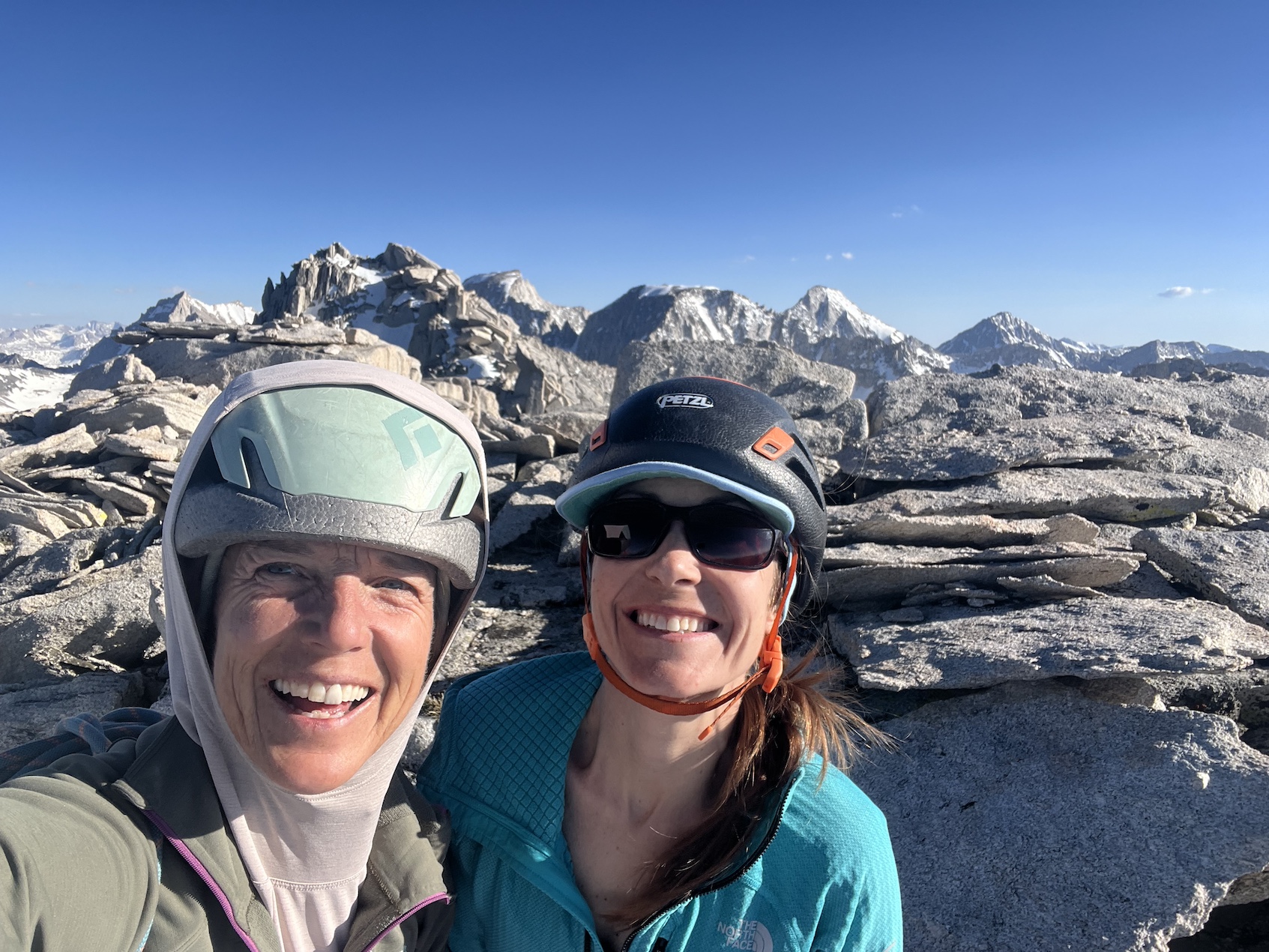
The hues of red and orange set against the glow of Ruby Peak’s snow covered ridge line melted away into twilight and a final long dark slog by headlamp down sandy switchbacks to the lake and our tent. The cold plunge would have to wait until morning. It was another great adventure, though nothing really went wrong. The day’s uncertainty unfolded into worked bodies and smiles as we fell horizontal into our sleeping bags.

Jeannie wall
she/her
Jeannie Wall has called Bozeman, Montana home since 1994. She spent 30 years developing technical products in the outdoor industry and recently founded Broad Beta, an initiative emboldening women through their shared stories to embrace wild ideas, wild experiences, and the preservation of wildness. She has also worked to develop local food systems and raced on a world-class level in Nordic and ski mountaineering. Now, she’s an avid climber, renowned throughout the tight-knit community.